
Dormant value sits in many places
Most organizations have a delivery system. Fewer have a learning system built into it.
That’s why improvement often arrives late, fragmented, or aimed at the wrong problem.
The first article in this three-part series made the point that results tell leaders what happened, not why it happened. The second showed why causes and solutions usually have to be found inside the organization’s own path to performance. This final article turns to what happens next: making that search part of how the organization operates.
If leaders want improvement to become routine, they have to build learning into the same path that produces the result.
That path runs from idea to adoption, delivery, satisfaction, repeat use, and recommendation. It includes prospects, customers, employees, managers, systems, handoffs, referral sources, and partners. Each participant may experience the process differently. Each point in the process may produce useful evidence.
Dormant value sits in many places: customer hesitation, employee workarounds, incomplete applications, referral leakage, renewal friction, handoffs, partner feedback, or data the organization already collects but does not fully interpret.
For example, an organization may already be generating inquiries or applications that never convert. The expensive work of creating interest has already been done, but not fully harvested. The immediate opportunity may be finding where the path weakens, why people stop, and what correction would help more of that earned opportunity become completed business.
That’s why the opportunity inside the pipeline can be so important. It’s often closer, more accessible, and less expensive to improve than opportunity the organization still has to create from the outside.
The right questions are practical.
Who is experiencing friction at this point?
Who sees the problem first?
Who has to explain, compensate, approve, interpret, refer, deliver, renew, or recover?
Who needs to know the correction was made?
These aren’t abstract process questions. They help identify where value is being created, weakened, delayed, or lost.
This applies to new products and services because the market will correct the plan. Early results are not just wins or losses. They are evidence about assumptions: who understood the offer, who hesitated, where the promise was credible, where the delivery path broke down, and what the market accepted, resisted, or ignored.
It also applies to existing products and services. History may show likely pressure points, but it can also dull attention. A familiar process may keep producing acceptable results while preventable failure, lost referrals, weak repeat behavior, or unrealized opportunity stays hidden inside the routine.
The market can’t be forced to confirm the producer’s plan. The organization has to learn where the plan is being confirmed, where it’s being corrected, and where it should be changed.
There is no standard recipe. But there is a path.
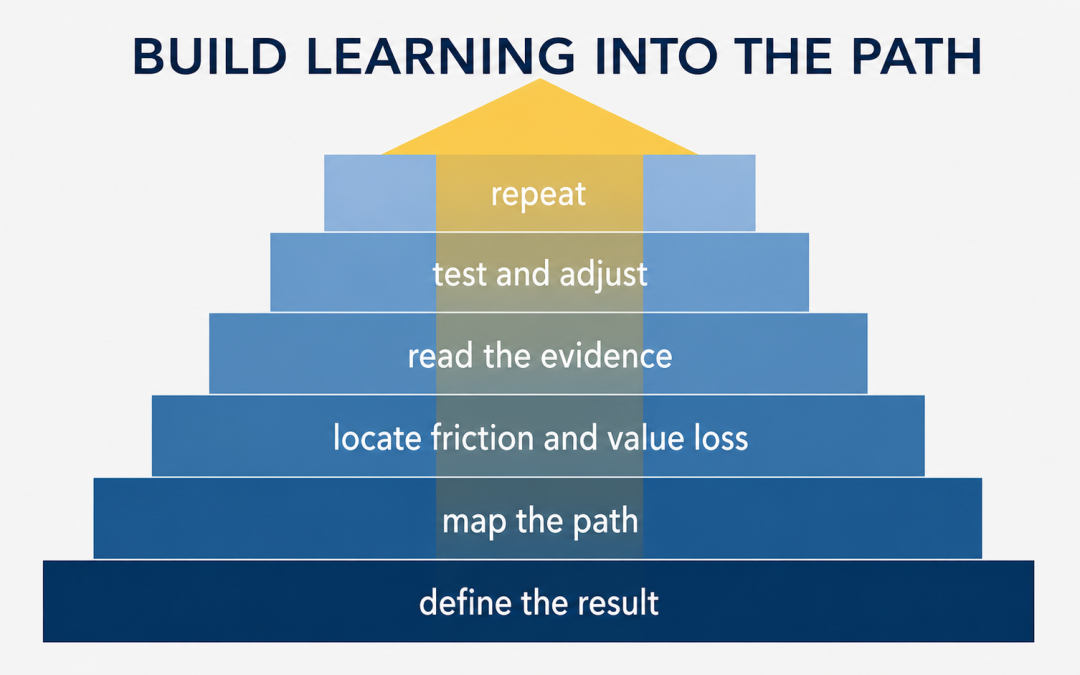
Start with the result the organization is trying to produce. Map the operating and transactional path that leads to that result. Identify the decision points, handoffs, expectations, and moments where value can be created or lost.
Then decide what evidence should appear at each point, who is responsible for reading it, and how explanations will be tested before action is taken. Make the change, measure whether it improved the result, and keep learning.
The process has to be scaled to the value of the goal. The point is not to create another expensive system. It’s to protect and improve net goal production: revenue, profit, retention, referrals, completed applications, repeat use, or whatever result the organization is trying to produce.
Properly applied, this work should be treated as an investment. It is intended to return more than it costs by stopping wasted activity, preventing avoidable losses, improving repeatable performance, strengthening lifetime value, and capturing value the organization was already missing.
But the system has to be built for the organization using it. Each organization has its own result path, market, customers, employees, handoffs, constraints, and opportunities. The discipline may be common, but the design cannot be generic.
When this discipline is absent, improvement becomes fragmented. One team sees a service problem. Another sees a marketing problem. Another sees a staffing problem. Another sees a technology problem. Each may be partly right. But without an engineered learning path, the organization may keep treating symptoms separately instead of understanding how the full system produces the result.
Improvement initiatives only create value if the organization is improving the right thing. Better execution can help when the path is sound. But if the assumptions are wrong, or if the market has changed, doing the same thing more efficiently may only produce the wrong result faster.
The goal is not to add another process. The goal is to build a practical discipline into the work itself: result, diagnosis, action, learning, adjustment, and repetition.
The return is delivered by the system: a practical way, built for the organization’s own path, to keep finding what can be improved, what should be protected, and where better results can be produced.
That is how improvement becomes routine rather than occasional, and how organizations improve results because they understand how those results are actually being produced.
If this raises useful questions about how your organization is producing its current results, we’d be glad to talk.